
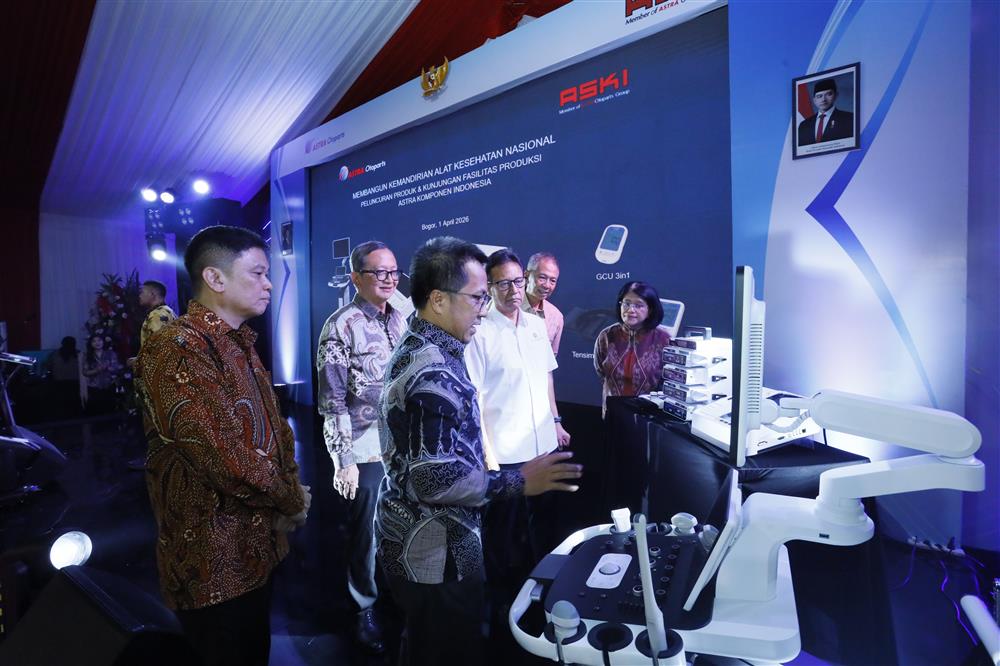
BOGOR: In line with the government’s strategy to strengthen the independence of the national healthcare sector, PT Astra Komponen Indonesia (ASKI), a subsidiary of PT Astra Otoparts Tbk, today (1/4) launched six digital technology-based medical devices.
The six medical devices introduced include a ultrasonography 4D system, syringe pump, infusion pump, 12-channel electrocardiograph, a blood pressure monitor integrated with glucose, cholesterol, and uric acid measurement (GCU 4in1), as well as GCU 3in1. These devices are integrated with digital applications and Artificial Intelligence-based predictive analytics to support more effective and integrated healthcare services.
By introducing digital technology-based medical devices supported by domestic research and development (R&D) capabilities and local manufacturing facilities, ASKI not only expands its domestic product portfolio but also contributes to increasing the utilization of locally produced medical devices in healthcare facilities, thereby supporting job creation and contributing to national economic growth.
This initiative is expected to strengthen national industrial capacity while reducing dependence on imported products. In addition, the presence of these medical devices reflects ASKI’s commitment to supporting healthcare services and community health screening initiatives.
The launch event was attended by the Minister of Health of the Republic of Indonesia, Budi Gunadi Sadikin; the Director General of Pharmaceuticals and Medical Devices of the Ministry of Health, Dr. Dra. Lucia Rizka Andalucia; and the Director General of Metal, Machinery, Transportation Equipment, and Electronics Industry of the Ministry of Industry, Solehan.
The Minister of Health of the Republic of Indonesia, Budi Gunadi Sadikin, expressed his appreciation for ASKI’s contribution to the medical device industry in supporting the resilience of the national healthcare system and job creation.
“There are three key reasons why we are encouraging the independence of the medical device industry in Indonesia. First, we aim to provide high-quality and affordable medical devices for the public. Second, by strengthening domestic medical device capabilities, we seek to ensure the resilience of the national healthcare system. Third, through this independence, the healthcare sector can create jobs and contribute to national economic growth,” said the Minister during the launch event.
“Through strengthening our R&D capabilities, developing domestic production facilities, and advancing technology-based medical devices, we are committed to delivering high-quality, competitive products that meet the needs of healthcare services in Indonesia. This initiative reflects our contribution to supporting the independence of the national medical device industry. We believe that the stronger the domestic medical device industry becomes, the greater our ability to provide high-quality, equitable, and sustainable healthcare services for the community, thereby enhancing the resilience of the national healthcare sector,” said Hamdhani Dzulkarnaen Salim, President Director of Astra Otoparts.
In addition to the product launch, the Minister of Health also visited ASKI’s plastic injection and medical device production facilities, R&D center, laboratory, and showroom to gain a comprehensive overview of the readiness of the domestic industry in developing and manufacturing technology-based medical devices.
According to data from the Ministry of Health of the Republic of Indonesia, the utilization of domestically produced medical devices in healthcare facilities has shown significant growth, increasing from approximately 12% in 2019 to around 48% in 2024. However, medical devices circulating in Indonesia are still dominated by imported products, with more than 59,000 foreign products compared to approximately 19,000 domestic products.
This condition underscores the importance of accelerating the strengthening of the national medical device industry to increase the use of locally produced medical devices and reduce dependence on imported products.
Through this launch, ASKI reaffirms its commitment to becoming part of a strong and sustainable national medical device industry ecosystem. Collaboration among the government (including the Ministry of Health and the Ministry of Industry), universities, industry players, and distributors is expected to accelerate the realization of national medical device independence while improving equitable access to healthcare services across Indonesia. Cross-sector collaboration is key to building a resilient and sustainable healthcare ecosystem.
This synergy is also reflected in ASKI’s collaboration with PT Darya-Varia Laboratoria Tbk in developing digital technology-based medical device solutions. This includes the development of the GCU 4in1 and 3in1 devices, which support screening and early detection of non-communicable diseases through data-driven technology.
GCU 4in1 is the first multifunctional device in Indonesia that integrates blood pressure, blood glucose, cholesterol, and uric acid measurements into a single unit. Meanwhile, GCU 3in1 provides a practical solution for measuring blood glucose, cholesterol, and uric acid. Both devices are designed to support early detection of non-communicable diseases and promote integrated, data-driven healthcare services, while enabling comprehensive and continuous health monitoring.
Furthermore, ASKI continues to direct its product innovation toward strengthening more promotive and preventive healthcare services. As such, its products not only contribute to industrial development but also to improving access to broader and more equitable healthcare services.
Since diversifying into the medical device sector in 2020, ASKI has continued to expand its product development and has now produced more than 30 types of medical devices, with a domestic component level ranging from approximately 40–59% and a company benefit weight of 12.7%. This achievement reflects ASKI’s tangible contribution to strengthening the national industry while supporting the empowerment of local small and medium enterprises.
All development processes—from product design and mechanical, electronic, and software system development to tooling—are carried out independently within the country. Through these efforts, ASKI reaffirms its role in building an independent, innovative, and globally competitive national medical device industry, while supporting improved access to and quality of healthcare services for the Indonesian population.